

Amino Plug is live. It is a Bakersfield company that sells reference-grade research peptides to labs and researchers, and as of this month it runs on a store I designed and coded from the ground up. No template, no page builder, and no monthly platform doing the heavy lifting behind the scenes. Every part of it, the storefront a customer sees and the back office the owners work in, was built for this one business. Here is what went into the project and why I built it the way I did.
What the owners actually needed
The owners came in with a real product line and a clear market. What they did not have was a store they could run without calling a developer every time a price changed or a batch sold out. That is the trap most small operations fall into. They rent a storefront, they rent the checkout, they rent the content editor, and three years in they are paying every month for a system they still do not control.
So the brief had two halves. Build a storefront that earns trust in a category where trust is everything. And build a back office the owners own outright, so the person who packs the orders is also the person who can edit a product, upload a document, or answer a question on the site without a support ticket. Both halves got built as one custom-coded platform.
A storefront that reads like a lab, not a supplement aisle
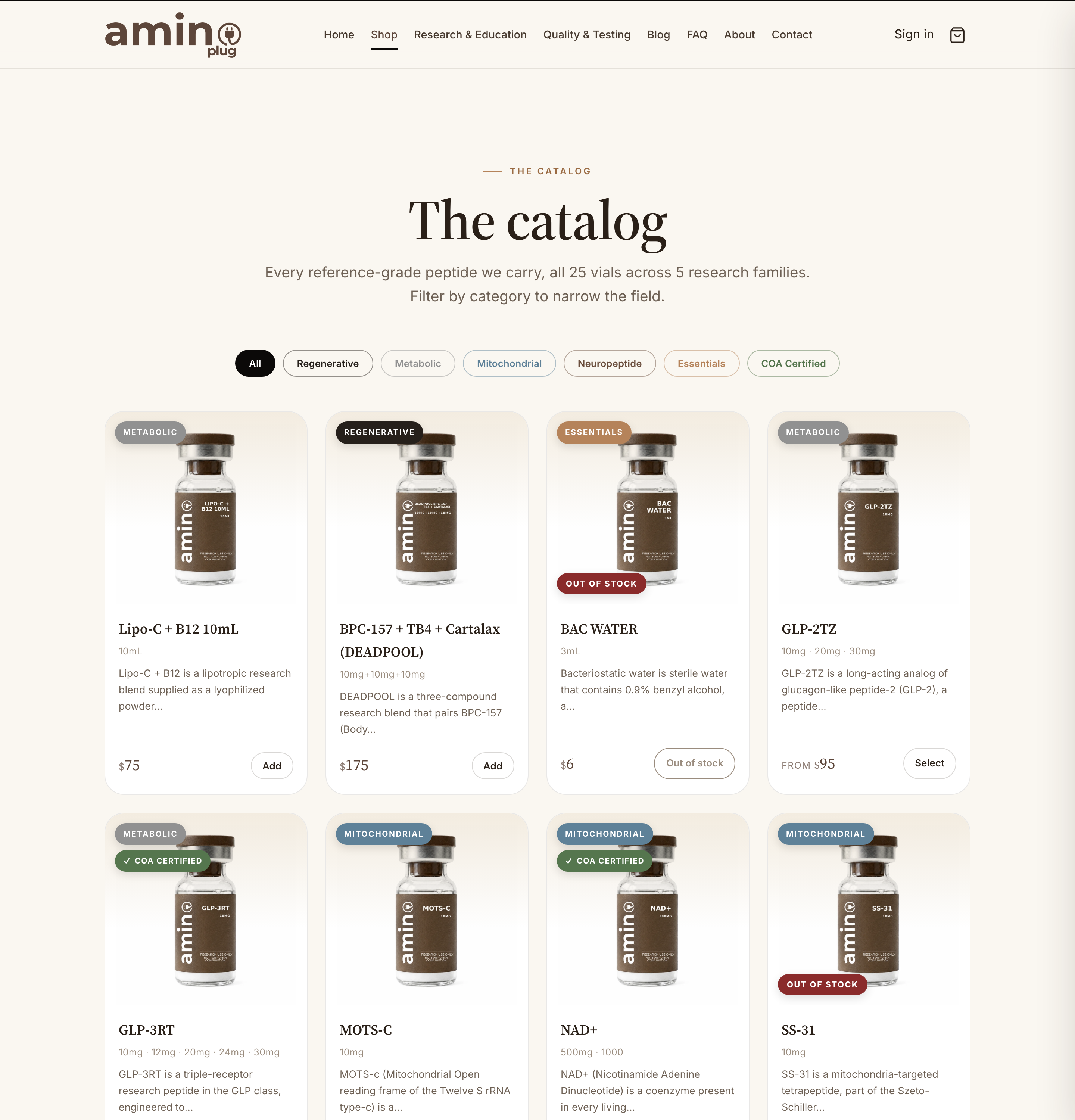
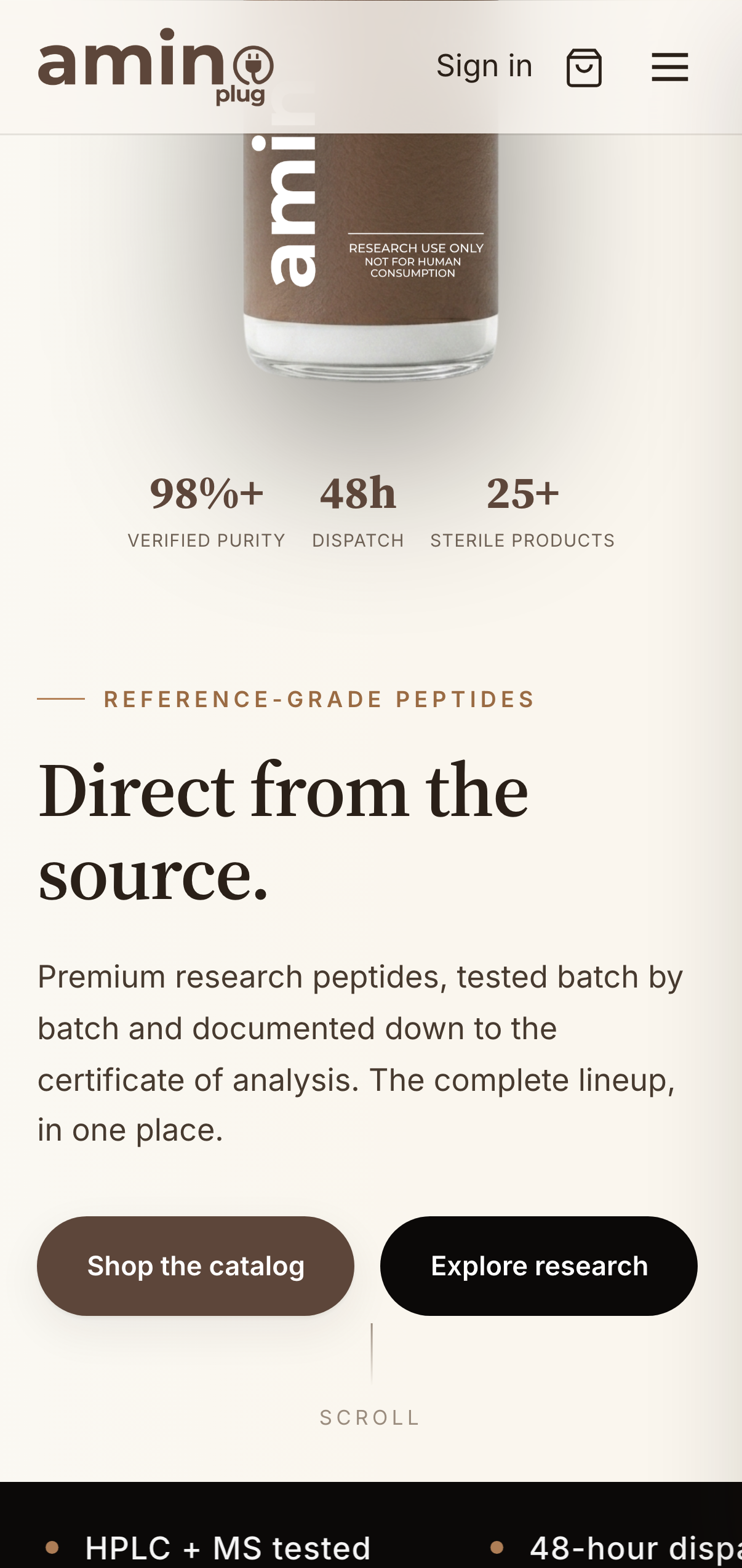
The look had to do a lot of work. Buyers in this space are wary, and for good reason. A store that looks like a late-night ad reads as a risk. So the brand sits in a warm cream, brown, and black palette with a serif and sans-serif type pairing. Clean, documented, closer to a lab bench than a health fad. I built a custom photography treatment for the vials so every product looks like it came from the same shelf, and a category color system that carries a shopper from the catalog into any of the five research families without getting lost.
The whole thing is mobile-first, responsive, and safe in dark mode, because most storefront traffic arrives on a phone. If you want the longer version of my thinking on brand consistency, it lives in the brand identity work I do for every build.
The part most stores rent, I built
This is the heart of the project. Behind the storefront is a hand-built content management system, no third-party editor bolted on. From one admin, the owners manage products with inline price and stock editing, size variants, categories, tags, and featured-product control. They upload a Certificate of Analysis as a PDF to any product, which flips on a “COA Certified” badge and feeds a filter shoppers can use to see only tested items.
It does not stop at products. The same admin runs orders, customers, reviews, a blog editor, an FAQ builder, a contact-module editor, an editable pages editor, and the newsletter list. The owners run all of it. That is the same approach I took on the Curbside Cuts custom build, where the goal was a business the owner controls, not a subscription they are stuck with. If you are weighing what a real custom application gets you over an off-the-shelf plan, this is it.
Selling responsibly in a regulated category
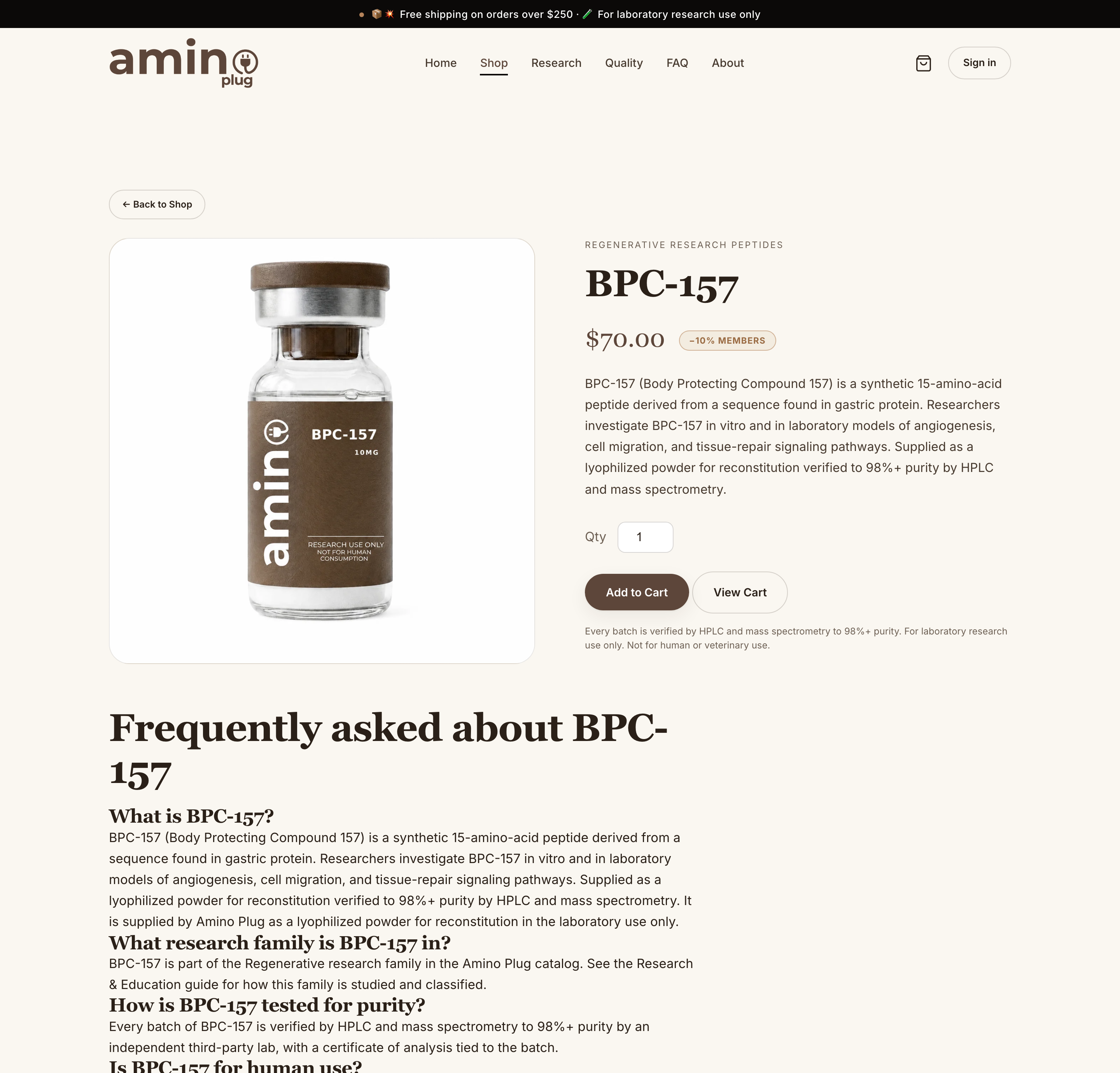
These are research-use-only products, sold strictly for laboratory and in-vitro research, and the platform has to say so at every turn. So the site opens with a 21-and-over research-use entry gate, carries research-use disclaimers throughout, and uses accurate product-form language everywhere. The products ship as lyophilized powder for reconstitution, so the copy says so instead of implying anything is ready to use. Getting this language right is not a legal footnote, it is part of the design.
Built to convert, not just to look good
The store runs a dynamic catalog, a cart, and a manual checkout flow with multiple payment options. Order tracking lets a customer follow a shipment. Out-of-stock and back-in-stock email notifications keep demand warm on items that sell out. Automated reminder emails go out on unpaid orders at 24 hours, 72 hours, and 7 days, which recovers sales that would otherwise slip away. Every product page also surfaces recommended items to keep a shopper moving through the catalog.
Getting found, by people and by AI
Before a word of copy went down, I ran market and competitor keyword research to shape the catalog structure and the page language around what buyers actually search for. Then I wrote the original, compliance-safe content the site needed to stand on its own: a Research and Education page, a Quality and Testing page, an About page, an FAQ, and three research-based blog posts covering how to reconstitute and store peptides, how to read a Certificate of Analysis, and a literature overview of BPC-157 and TB-500.
Under the hood, the findability plumbing is all there. Structured data and JSON-LD so search engines understand the catalog. A live sitemap. A database-driven llms.txt so AI search tools can read an accurate picture of the store. Meta and breadcrumb coverage across the site, and Open Graph share cards so a link looks right when it lands in a text or a post.
Launch day
Launch is where a lot of custom projects stumble, so I handle it end to end. For Amino Plug that meant the domain cutover and DNS, the SSL certificate, Google sign-in setup, Google Analytics 4, and Google Search Console verification, plus HTTPS redirects so no old link breaks. The result is a self-managed storefront the owners run themselves, live now at aminoplug.com, built and launched in July 2026.
If you are sitting on a product line and a platform bill that keeps climbing, or you want a store you actually own instead of one you rent, that is the kind of e-commerce build I do. Tell me what you are selling and I will tell you whether a custom build is the right call.
Frequently asked questions
What is Amino Plug?
Amino Plug is a Bakersfield, California e-commerce company that sells reference-grade research peptides to researchers and labs, strictly for laboratory and in-vitro research use. The catalog runs about twenty-five products across five research families.
Was this a template or a custom build?
A custom build. The storefront and the admin were coded from the ground up for this one business, with no third-party page builder or rented store platform underneath. The owners own the whole thing.
Can the owners update the store themselves?
Yes. A hand-built content management system lets them edit prices and stock, manage products and categories, upload Certificates of Analysis, moderate reviews, and publish blog posts and pages, all from one admin. No developer needed for day-to-day changes.
What is a Certificate of Analysis and why does it show on the site?
A Certificate of Analysis is the lab document that reports a batch's purity and identity. On Amino Plug it uploads per product, turns on a COA Certified badge, and feeds a filter, so buyers can see exactly which items have testing documentation attached.
When did Amino Plug launch?
The store went live in July 2026, including the domain cutover, SSL, analytics, and search-console setup. It is live now at aminoplug.com.
Do you build custom e-commerce for other businesses?
Yes. Custom storefronts, custom admins, and the launch operations to get them live are core to what I do. You can see the e-commerce service or send me the details of your product line.


